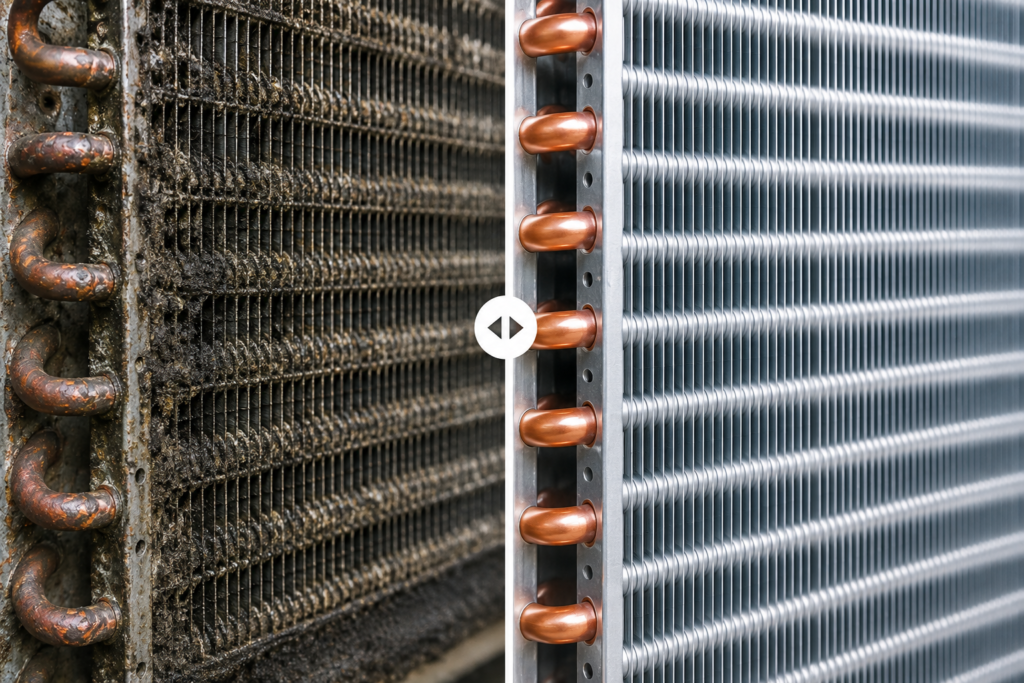
In commercial HVAC engineering, system efficiency relies on how effectively an Air Handling Unit (AHU) or Rooftop Unit (RTU) transfers thermal energy while overcoming static pressure resistance. While traditional maintenance uses harsh alkaline or acidic chemicals that clean only surface fins, AC Bio Clean uses a proprietary probiotic bio-cleaning formulation that digests deep internal coil biofilm to restore maximum volumetric airflow (CFM) and reduce continuous facility HVAC energy consumption by 18% to 30%.
According to guidelines from the U.S. Department of Energy (DOE) and ASHRAE, removing microscopic biological buildup on heat exchanger coils reduces static pressure drop across the coil matrix, lowering fan motor amperage (kW) and compressor runtime. AC Bio Clean’s micro-spores penetrate the full depth of multi-row commercial coil banks, delivering continuous 90+ day biofilm breakdown with zero system downtime or metal degradation.
1. The Physics of Coil Fouling: Static Pressure ($P_s$) & Airflow (CFM)
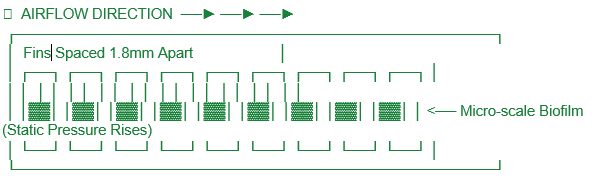
Commercial evaporator coils consist of complex arrays of micro-channel fins, often spaced at 10 to 14 fins per inch. In high-demand environments—such as commercial kitchens, hotels, and healthcare facilities—airborne grease mist, microscopic organic dust, and moisture condense on these fins. This mixture creates a dense, microscopic rubbery matrix known as biofilm.
The Fluid Dynamics Penalty
As biofilm coats the microscopic gaps between fin walls, the effective cross-sectional open area ($A$) of the heat exchanger drops sharply. According to fluid dynamics principles governing internal duct and fin airflow, restricting area directly increases air velocity through remaining gaps and causes a rise in static pressure drop ($\Delta P_s$) across the coil matrix.
Static pressure functions as internal resistance against the blower motor. When $\Delta P_s$ rises:
- Volumetric Airflow Drops: Total Cubic Feet per Minute (CFM) decreases, starving downstream spaces of conditioned air.
- Fan Workload Spikes: Variable Frequency Drive (VFD) fan motors accelerate to maintain setpoint CFM, drawing higher continuous electrical amperage.
- Heat Transfer Resistance Multiplies: Biological film acts as a thermal insulating blanket. The overall heat transfer coefficient ($U$) degrades:
$$Q = U \cdot A \cdot \Delta T_{\text{LMTD}}$$
When $U$ drops, the system must circulate more chilled water or run compressors significantly longer to achieve equivalent sensible heat removal ($Q$).
2. Mathematical Proof: Fan Laws & Utility Energy Impact
The direct link between static pressure reduction and energy savings is backed by foundational fluid physics.
The power drawn by an HVAC fan motor ($kW_{\text{fan}}$) scales proportionally with volumetric airflow ($CFM$) and total static pressure ($P_s$) divided by total fan efficiency ($\eta_{\text{fan}}$):
$$\text{Power } (kW_{\text{fan}}) = \frac{\text{CFM} \times P_s}{3300 \times \eta_{\text{fan}}}$$
When a heavily fouled coil suffering an elevated static pressure drop (e.g., rising from a design baseline of $0.45\text{ in. w.g.}$ up to $0.75\text{ in. w.g.}$) is cleared using AC Bio Clean probiotic treatment, internal resistance drops back to factory tolerances.
Utility & Industry Standards Verification
Major utility bodies—including Florida Power & Light (FPL), Duke Energy, ASHRAE, and the U.S. Department of Energy (DOE)—state in commercial efficiency frameworks that coil maintenance provides measurable energy savings:
- U.S. DOE Data: A layer of biofilm just $0.009\text{ inches}$ ($0.23\text{ mm}$) thick can reduce overall system efficiency by up to 21%, driving up compressor running time and total energy consumption.
- ASHRAE & Field Case Studies: Documented baseline AHU coil restorations show static pressure drop decreases of 14% to 35%, producing 15% to 30% reductions in total facility fan and refrigeration kW demand.
- AC Bio Clean Verified Results: Commercial hotel case studies (such as the Cadillac Hotel in South Florida) show documented energy reductions averaging 24% and airflow restoration above 30%.
➡️ View Cadillac Hotel Case Study
Lower static pressure allows fan motors to dial back operational frequency (VFD output) while maintaining target CFM, delivering instant energy reductions visible on facility sub-meters.
3. Deep Microscopic Spore Migration Across Multi-Row Coils
Commercial HVAC cooling coils vary in size, ranging from standard packaged units up to massive multi-row central Air Handling Units (AHUs) found in large commercial facilities and hotel properties.
| TRADITIONAL CHEMICAL CLEANING | PROBIOTIC BIO-CLEANING (AC BIO CLEAN) |
| Cleans 1st inch of outer fin face only | Spores migrate through full coil depth |
| Chemical stops active cleaning on rinse | Continuous 90+ day biological breakdown |
| Caustic acid/alkaline oxidizes metal fins | 100% Non-corrosive, extends coil |
The Physical Limits of Traditional Chemicals
High-pressure chemical sprays collapse delicate aluminum fin geometries on impact and rarely penetrate beyond the first inch or two, often compacting internal debris deeper into the center of thick coil assemblies. Furthermore, traditional chemical washes stop working the instant they are rinsed away.
Microscopic Spore Migration
In contrast, AC Bio Clean deploys active probiotic spores alongside bio-surfactants. Because of their microscopic size (sub-micron range), these proprietary probiotic spores naturally migrate throughout the full depth of the coil structure.
Once inside the internal core, the spores colonize the deepest fin matrices, hydrolyzing complex fats, oils, and biological matrices that standard pressure washing and chemical foams physically cannot reach.
Continuous 90+ Day Residual Protection
AC Bio Clean establishes a competitive biological barrier on coil surfaces. As long as ambient humidity and organic contaminants pass through the coil, the resident beneficial microbes remain active, consuming incoming organic debris continuously for 90+ days to maintain low static pressure and maximum CFM.
4. Operational Comparison Matrix
| Technical Metric | Probiotic Bio-Cleaning (AC Bio Clean) | Traditional Caustic Chemical Cleaning |
| Deep Coil Penetration | Micro-spores colonize the full depth of multi-row coils. | Surface level (top 1–2 inches); pushes internal debris into coil core. |
| Residual Biofilm Defense | Active 90+ Days: Microbes continuously digest incoming contaminants. | Zero: Biofilm re-colonization begins immediately after rinse. |
| Fin Geometry Protection | 100% pH-balanced, non-corrosive, extends unit life by 3–5 years. | Highly corrosive; oxidizes aluminum fins and strips protective coatings. |
| Operational Downtime | Zero Shutdowns: Non-toxic, zero harsh fumes; applied in 5 mins while units run. | High Downtime: Requires system isolation, occupant evacuation, and containment wash-down. |
| Static Pressure Impact | Permanently maintains design $\Delta P_s$ through continuous digestion. | Temporary reduction in $\Delta P_s$; spikes again as biofilm quickly returns. |
Conclusion
Restoring heat transfer and fan performance does not require harsh chemicals or operational shutdowns. By pairing fluid dynamics principles with continuous AC Bio Clean probiotic bio-cleaning, commercial facilities can maintain baseline static pressure drop, deliver maximum airflow CFM, reduce overall facility kWh usage by 18% to 30%, and extend equipment operating lifespan by 3 to 5 years.
5. Frequently Asked Questions
Q: How does probiotic AC coil cleaning lower HVAC energy usage?
A: Probiotic cleaning by AC Bio Clean digests the dense biofilm clinging to cooling coil fins. Removing this barrier reduces static pressure drop across the coil, allowing the blower motor to pull less amperage (kW) while maintaining peak volumetric airflow (CFM).
Q: Can probiotic spores penetrate deep multi-row coils?
A: Yes. Unlike pressure washers or chemical foams that only reach the outer fin surface, AC Bio Clean probiotic spores are microscopic and naturally migrate deep inside the interior center matrix of multi-row commercial cooling coils.
Q: Does AC Bio Clean probiotic coil cleaning cause facility downtime?
A: No. AC Bio Clean utilizes a 100% non-toxic, pH-balanced, bio-enzymatic formula with zero VOCs or harsh chemical off-gassing, allowing application in 5 minutes per unit during active operations with zero system downtime.